der Naturwissenschaften
und der Technik
 Verlagsprogramm
Wissenschaftsgeschichte
Technikgeschichte
Mathematikgeschichte
Medizingeschichte
Editionen + Reihen
Sachgebiete
Suche
Service
How to Order
Kontakt



Crystal Engineering—Designing Complexity
Overview | TOC | Preface | Links
|
Gautam R. Desiraju |
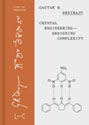
Table of Contents
Prologue
1 Early Days: From Bombay to the U. S.
1.1 Childhood and family: almost a midnight child
1.2 Adolescence in Bombay: what a city!
1.3 The United States of America (1972 – 1978)
2 From the U.S. to Hyderabad via Bangalore
2.1 Interregnum in Bangalore (1978 – 1979)
2.2 The University of Hyderabad: jungle man
2.3 Intermolecular interactions: how molecules talk to each other
3 Crystal Engineering: The Design of Organic Solids
3.1 Origins of the 1989 book: redefinition of crystal engineering
3.2 Beginnings of a new idea: epiphany and the four voices
3.3 Intelligence augmentation with the CSD: codebreaking
3.4 Chemical Communications or ChemComm
3.5 Hydration in organic crystals
4 Supramolecular Synthons and a New Organic Synthesis
4.1 Molecular synthesis: making and breaking covalent bonds
4.2 Retrosynthesis: inductive logic
4.3 Supramolecular synthesis: making and breaking intermolecular interactions
4.4 The supramolecular synthon: the core of a crystal structure
4.5 Introduction to the International Union of Crystallography
5 The Weak Hydrogen Bond: What Is “Weak”?
5.1 My Austrian collaborator
5.2 Strong and weak hydrogen bonds
5.3 Resistance to our ideas — from a big gun
5.4 Writing the book
5.5 Two new crystal engineering journals
5.6 Germany and the Alexander von Humboldt Stiftung
5.7 Fluorobenzenes: tilting at windmills
6 Interactions, Synthons, and Structural Design: Strategies of War
6.1 A holistic view: emergence vs reductionism
6.2 Carboxylic acids: backbone of synthon theory
6.3 Phenols and aminophenols: conformational freedom
6.4 Multicomponent crystals and crystallisation: an oxymoron?
7 Going Native into the Indian Scientific System
7.1 Department of Science and Technology: the idea of “Delhi”
7.2 Deanship of the school of chemistry in the University of Hyderabad
7.3 Council of Scientific and Industrial Research
7.4 The Asian connection
7.5 Polymorphism: no more a nemesis
7.5.1 Crystal Structure Prediction (CSP): it’s not guesswork
7.5.2 CSP and AI: brute force solutions — AI and scientific publishing
7.5.3 Back to polymorphism: same molecule, different crystal structures
7.6 The Gordon Research Conference (GRC) 2010: a battle royal
8 Return to the Indian Institute of Science
8.1 Back in Bangalore: return of the native
8.2 From an idea to a textbook in 30 years
8.3 Bending and twisting molecular crystals to order
8.4 Synthesis of higher cocrystals: how many components can you introduce?
9 The International Union of Crystallography
9.1 What is a crystal?
9.2 Member Executive Committee of the IUCr (2005 – 2011)
9.3 IUCr president
9.4 International year of crystallography (2014)
9.4.1 Reflections on the importance of IYCr 2014
9.4.2 Crystallography and geostrategies
9.5 Bringing the IUCr home: the 2017 Hyderabad congress
10 A Continuing Thought Stream Beyond Crystal Engineering
10.1 Thoughts on chemistry
10.2 On doing chemistry and being a teacher — researcher in India
10.3 Reductionism and holism in chemistry
10.4 End of the reductionist dogma in chemistry?
10.5 Science and politics: why they are connected
10.6 On being a scientist
10.7 Indian Knowledge Systems
11 Epilogue
Appendix
Vita
Chemistree
Touchstones
Holographs
Publications
Table of contents
Links
Image sources
Index


